
Have you ever thought… What if the cinema did not have to be a building?
What if the screen could come to a university campus, a corporate venue, a community, a private event or an open space under the stars?
That is the idea behind mobile cinema.
Mobile cinema brings the movie-going experience beyond the walls of a traditional theatre. It combines professional projection, sound, event production and audience management to create a cinema experience in locations that may not have a permanent cinema.
But mobile cinema is about more than putting a large screen somewhere and pressing play.
The best mobile cinema experiences turn a location into an event.
At Imagine Cinemas, that means bringing premium cinema experiences directly to audiences through mobile screenings, community events, campus tours and corporate activations. The company describes its approach as connecting entertainment and marketing through immersive cinema experiences, strategic brand activations and audience engagement.
In simple terms:
Cinema does not always have to be somewhere you go. Sometimes, cinema can come to you.
What is mobile cinema?
Mobile cinema is a temporary or portable cinema experience that can be created in different locations instead of relying on a permanent cinema building.
Depending on the type of event, it can involve a large projection screen, professional projector, sound system, power supply, seating, lighting, event staff and audience management.
The location could be a university campus, hotel, corporate facility, park, community space, event centre or private venue.
This idea is not new. Mobile and outdoor cinema have existed in different forms for decades. UNESCO’s Institute for Statistics recognises mobile unit cinemas and outdoor cinemas among forms of cinema facilities that use projection equipment.
The term can also describe different formats. Some mobile cinemas use vehicles or trailers equipped specifically for screenings, while others transport cinema equipment to a location and build the experience there.
For modern events, the second approach offers enormous flexibility.
Instead of asking:
“Where is the nearest cinema?”
The question becomes:
“Where do we want people to experience cinema?”
That difference is important.
Mobile cinema is more than an outdoor movie
It is easy to think of mobile cinema as simply an outdoor movie night.
An outdoor movie screening is certainly one type of mobile cinema experience. Outdoor cinemas generally use a projector, large screen and sound system to show films in an open environment.
But mobile cinema can go much further.
Imagine a university courtyard transformed into a cinema for hundreds of students.
Or a company hosting an exclusive film screening for its clients. Or a brand creating a travelling cinema experience across several cities. Or a community gathering for an educational film and discussion.
The film is still at the centre of the experience, but everything around it can be designed to serve a larger purpose.
That could be entertainment, it could be community engagement, it could be brand awareness, it could be student engagement, it could be a corporate celebration, it could even be a marketing campaign.
Now, that is where mobile cinema becomes particularly interesting.
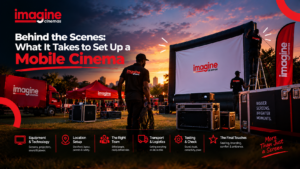
How does mobile cinema work?
A successful mobile cinema event involves considerably more planning than most audiences see.
The goal is to make the experience feel effortless for the people attending.
Behind the scenes, however, several moving parts have to work together.
1. Choosing the right location
The first consideration is the venue.
A good location needs to work for both the audience and the technical production.
Event organisers need to consider:
- Available space
- Audience capacity
- Accessibility
- Power availability
- Ambient lighting
- Noise levels
- Weather conditions
- Parking and transport
- Safety
- Screen visibility
- Equipment access
An attractive location is not necessarily a good cinema location.
For example, trees, buildings, poles or other obstructions can affect the audience’s view. Outdoor cinema providers also advise organisers to consider these obstacles when assessing a venue.
The location has to work as part of the production.
2. Setting up the cinema
Once the venue has been selected, the technical environment has to be created.
Depending on the event, this can include:
- A large cinema screen
- Professional projection equipment
- Cinema-quality sound
- Media playback equipment
- Power solutions
- Lighting
- Seating
- Stage or event infrastructure
- Technical support
The equipment should be appropriate for the size and environment of the event.
A screening for 50 people in a private venue has very different requirements from a campus activation designed for hundreds or thousands of people.
This is one reason professional mobile cinema production matters. The objective is not simply to make the film visible. The objective is to make the audience feel like they are at the cinema.
What equipment does a mobile cinema need?
The exact equipment will depend on the venue, audience size and type of experience, but a professional mobile cinema may require the following:
| Equipment | Purpose |
| Cinema screen | Provides a large viewing surface |
| Professional projector | Displays the film at the required quality |
| Sound system | Delivers clear and immersive audio |
| Media playback system | Handles the film or other content |
| Power solution | Keeps the production running |
| Lighting | Creates atmosphere and supports safety |
| Seating | Provides audience comfort |
| Event infrastructure | Supports the wider event experience |
| Technical equipment | Ensures reliable production |
There are also specialist formats.
For example, some outdoor cinema providers offer drive-in screenings where audiences watch from their cars, while silent cinema formats can allow audiences to listen through headphones rather than a conventional loudspeaker system.
The technology can change.
The purpose remains the same:
Create a great cinema experience wherever the audience is.
Where can mobile cinema be used?
One of the biggest advantages of mobile cinema is flexibility.
You are not limited to a traditional cinema auditorium.
Universities and campuses
Universities are natural environments for mobile cinema.
A campus screening can become much more than a movie night. It can form part of student orientation, a social programme, a student association event, a brand activation or a wider campus entertainment tour.
Imagine Cinemas’ campus cinema offering is specifically designed to bring cinema experiences to universities while creating opportunities for brands to connect with young audiences.
A well-planned campus screening can combine the film with music, food, games, brand experiences, photography and other activities.
The result is an event students remember.
Corporate events
Companies are increasingly looking for entertainment experiences that feel different from the usual dinner, conference or networking event.
A mobile cinema can be used for:
- Employee entertainment
- Client appreciation
- Corporate celebrations
- Product launches
- Internal events
- Executive screenings
- Staff engagement
- Brand experiences
The experience can also be customised around the organisation.
Imagine Cinemas, for example, offers VIP experiences that include executive screenings, movie premieres, celebrity experiences, client appreciation events and exclusive networking opportunities.
Brand activations
This is where cinema becomes particularly powerful for marketers.
Instead of simply placing a logo at an event, a brand can become part of the experience.
A company could sponsor a cinema tour, create a branded movie night, integrate product experiences into the event or build an activation around a film audience already cares about.
Imagine Cinemas positions brand activations around experiential marketing, product launches, roadshows, corporate activations and promotional events.
The key is relevance.
People should not feel like they have attended an advertisement.
They should feel like they have attended a great event that happened to be powered by a brand.
Communities
Cinema can also bring people together around shared stories.
Community screenings can support entertainment, education, awareness campaigns and social initiatives.
Historically, mobile cinema has been used to take films and educational content to communities that did not have easy access to permanent cinemas.
That idea remains relevant.
The technology has evolved, but the basic principle has not:
bring the story closer to the people.
Private events
Mobile cinema can also transform private occasions.
Think birthdays, family celebrations, private parties, estate events, hospitality experiences and VIP gatherings.
Instead of simply hiring entertainment for an event, organisers can create an entire cinema environment around the occasion.
Mobile cinema vs traditional cinema
Mobile cinema is not necessarily a replacement for traditional cinemas.
The two simply offer different experiences.
| Mobile Cinema | Traditional Cinema |
| Can be brought to different locations | Operates from a permanent location |
| Can be designed around a specific event | Follows a standard cinema format |
| Can incorporate branding and activations | Usually has limited event customisation |
| Can combine cinema with other activities | Primarily focused on film screenings |
| Can serve specific communities or audiences | Audience travels to the cinema |
| Flexible location and event format | Fixed location and infrastructure |
Traditional cinemas remain valuable because they provide a dedicated, controlled environment built specifically for film.
Mobile cinema offers something different.
Flexibility.
The location becomes part of the experience.
A campus is not just a venue.
A rooftop is not just a venue.
A corporate space is not just a venue.
The environment can become part of the story.
Why is mobile cinema becoming interesting for events and brands?
Entertainment has changed.
People have more ways than ever to watch films.
They can stream movies at home, watch content on their phones or use increasingly sophisticated home entertainment systems.
So why would someone leave home to attend a movie screening?
Because the experience is different.
People do not only remember what they watched.
They remember where they were, who they were with and how the experience made them feel.
That is one reason cinema can work particularly well within experiential entertainment.
A screening can become a social occasion.
A brand activation can become a night out.
A university event can become a shared memory.
A community programme can create a space for people to gather around a story.
This is also where the relationship between entertainment and marketing becomes interesting.
A strong experience gives a brand an opportunity to participate in a moment rather than simply interrupt it.
What makes a great mobile cinema experience?
Buying a screen and projector is not enough.
A memorable mobile cinema experience requires thoughtful planning.
Here are six things that matter.
1. The right film
The content should make sense for the audience.
A campus audience, corporate audience, family audience and community audience may all have very different expectations.
The film should fit the occasion.
2. Good technical quality
Nobody wants to struggle to see a dim image or hear dialogue over background noise.
Projection, sound and playback quality are fundamental.
The technology should disappear into the experience.
The audience should simply feel like they are watching a great film.
3. The right environment
Location affects the experience.
A screening under the stars feels different from one inside a conference venue.
A campus courtyard creates a different atmosphere from an executive event.
The venue should support the experience rather than fight against it.
4. Good event production
Arrival matters.
Registration matters.
Seating matters.
Lighting matters.
Sound matters.
The transition before the film matters.
The experience should feel organised from the moment guests arrive.
5. Audience engagement
The film does not have to be the only thing happening.
Depending on the event, organisers can introduce:
- Music
- Games
- Food
- Photo opportunities
- Product experiences
- Competitions
- Host or MC segments
- Interactive activities
The right additions can make the evening feel like an event rather than simply a screening.
6. Measurement
For brands and organisations, the event should have a purpose.
How many people attended?
How many registered?
How many engaged with the activation?
What did the audience think?
How many leads were generated?
What did people share?
Good experiential entertainment can be enjoyable and measurable at the same time.
How to plan a mobile cinema event
If you are considering organising a mobile cinema experience, start with the objective rather than the equipment.
Step 1: Define the purpose
Ask:
Why are we doing this?
Is it entertainment?
Brand awareness?
Community engagement?
Student engagement?
Customer appreciation?
Fundraising?
The answer will influence almost every other decision.
Step 2: Understand your audience
Who is attending?
What do they enjoy?
How many people are expected?
What would make the experience valuable to them?
Step 3: Choose the venue
Assess the space, accessibility, power, visibility, safety and audience capacity.
Step 4: Select the film or content
Choose something appropriate for the audience and the purpose of the event.
Remember that screening films publicly can involve licensing requirements. Those requirements should be addressed before promoting the event.
Step 5: Plan the production
Think through:
Screen → Projection → Sound → Power → Seating → Lighting → Staffing → Safety
Do not leave technical planning until the day of the event.
Step 6: Plan registration and ticketing
If the event is ticketed, registration and ticketing should be simple.
For larger experiences, digital ticketing can also help organisers understand attendance and manage the audience.
Imagine Cinemas provides digital ticketing integrated with its event management system as part of its service offering.
Step 7: Promote the experience
Give people a reason to attend.
Do not simply announce:
“Movie screening this Saturday.”
Tell them what the experience will feel like.
Step 8: Deliver the event
On the day, the audience should not have to think about everything happening behind the scenes.
They should arrive, settle in and enjoy themselves.
Step 9: Measure the outcome
After the event, look at attendance, engagement, feedback and other relevant outcomes.
That information can make the next experience even better.
How much does mobile cinema cost?
There is no single price for a mobile cinema event.
The cost depends on what you are trying to create.
Factors can include:
- Number of guests
- Location
- Event duration
- Screen requirements
- Projection requirements
- Sound requirements
- Seating
- Power
- Staffing
- Event production
- Branding
- Entertainment
- Ticketing
- Logistics
A private screening for 50 guests will naturally require a different production from a branded campus experience for several hundred people.
That is why a good mobile cinema provider should first understand the event before recommending a production package.
The question should not simply be:
“How much is a mobile cinema?”
A better question is:
“What kind of experience are we trying to create, and what will it take to deliver it properly?”
What is the future of mobile cinema in Africa?
Africa does not have to experience cinema in only one way.
As entertainment, technology, marketing and event culture continue to evolve, there is an opportunity to rethink where and how people experience films.
That could mean more campus cinema tours.
More community screenings.
More corporate experiences.
More brand-led cinema events.
More creative outdoor screenings.
More partnerships between entertainment companies and brands.
It could also mean using technology to make event registration, ticketing and audience engagement more sophisticated.
But the most important part will remain human.
People want experiences they can share.
They want reasons to leave the house.
They want moments they can talk about afterwards.
Cinema already has something powerful at its centre: a story watched together.
Mobile cinema simply changes where that story can be experienced.
Cinema Without Walls
A cinema does not have to begin with a building.
It can begin with an audience.
It can begin with a story.
It can begin with a brand looking for a better way to connect with people.
It can begin on a university campus, in a corporate venue, in a community or under an open sky.
That is the opportunity mobile cinema creates.
At Imagine Cinemas, the goal is to bring premium cinema experiences directly to audiences through mobile screenings, campus experiences, community events, corporate activations and other customised experiences. The company says it has delivered more than 500 cinema experiences, reached over 1 million audience members and worked with more than 100 brand partners.
The bigger idea is simple:
Cinema should not always be limited by where the cinema building is.
Sometimes, the best cinema experience is the one that comes to you.
Ready to bring cinema to your audience?
Whether you are planning a corporate event, campus activation, community screening, brand campaign or private cinema experience, Reach out to Imagine Cinemas to help you design and deliver an experience around your audience, location and objectives.
Cinema Without Walls.
Plan your experience with Imagine Cinemas.
Frequently Asked Questions
What is mobile cinema?
Mobile cinema is a temporary or portable cinema experience that can be delivered in different locations instead of relying on a permanent cinema building.
How does mobile cinema work?
A mobile cinema provider transports and sets up the required projection, screen, sound, power and event equipment at the chosen location, then manages the screening and audience experience.
Can mobile cinema be held outdoors?
Yes. Outdoor screenings are one of the most common forms of mobile cinema. They can take place in suitable parks, campuses, event spaces, rooftops, gardens and other open locations.
What equipment is needed for a mobile cinema?
A professional setup may include a large screen, projector, sound system, playback equipment, power, lighting, seating and technical production equipment.
Can businesses use mobile cinema for marketing?
Yes. Cinema can be incorporated into experiential marketing campaigns, product launches, corporate activations, roadshows and customer engagement programmes. Imagine Cinemas specifically offers brand activation services built around these types of experiences.
Can universities organise mobile cinema events?
Yes. Universities can use mobile cinema for student entertainment, campus activations, student association events, orientation programmes and brand partnerships.
Can mobile cinema be used for community events?
Yes. Mobile cinema can be used for community entertainment, educational screenings, awareness programmes and social-impact initiatives.
How much does a mobile cinema event cost?
There is no universal price. Costs depend on factors such as audience size, location, equipment, production requirements, duration, branding, staffing and logistics.