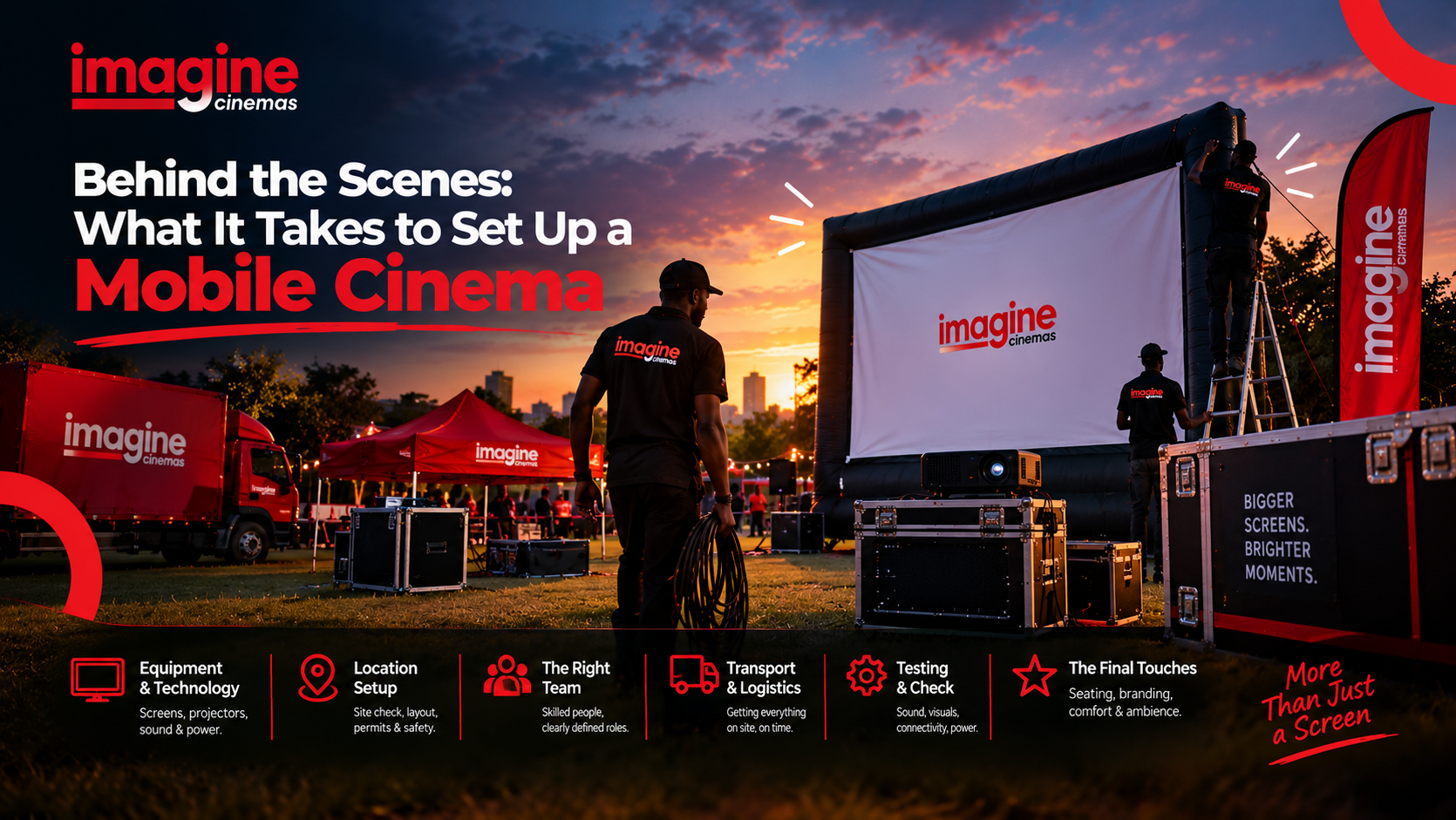
When guests walk into a mobile cinema event, they see a big screen, a good film and a crowd that is already in the mood. They do not see the work that happened before the first guest arrived.
A good mobile cinema setup is a chain of decisions: about the location, the power, the sound, the timing and the people. If one link fails, the audience notices. If all of them hold, nobody thinks about the setup at all. That is the goal.
This is what goes on behind the screen at Imagine Cinemas, and what you should expect from any team you hire.
1. It starts with understanding the event
Before anyone talks about equipment, we ask what the event is for.
A brand launch, a campus movie night, a corporate screening and a community outdoor show are four different jobs. Each has its own audience, mood and success measure.
The questions that shape everything else:
- Who is coming, and how many?
- Is the screening the main event, or part of a larger programme?
- What should guests feel and remember?
- Is it indoors, outdoors, or a mix?
- What does the organiser need to see afterwards (reach, leads, attendance, goodwill)?
The answers decide the screen size, the sound plan, the timeline and the crew. A setup built for 150 students on a field is wrong for a 60-person executive screening.
2. Preparing the location before the equipment arrives
Good cinema is lost on bad ground. The site visit is where many problems are solved cheaply.
Here is what we check:
- Space and access. Can the vehicle get in? Is there a clear route for equipment? Where do guests enter and sit?
- Visibility. Will every seat have a clear line of sight? Are there poles, trees or buildings in the way?
- Ambient light. Streetlights, security lights and car park floodlights all wash out a picture. Can they be dimmed or turned off?
- Surface. Is the ground level and firm enough for the screen frame and seating?
- Weather. Rainy-season evenings and harmattan dust need different plans. Wind is the screen’s biggest enemy outdoors.
- Safety. Cables away from walkways, clear exits, and a crowd flow that makes sense.
In Nigeria, add one more question: power. Never assume the venue’s supply will hold for three hours. We ask what is available, what is stable and what the backup is.
3. Getting the screen, projection and sound right
Equipment must fit the environment and the crowd. Bigger is not always better.
Screen. Size and placement come from the viewing distance and the number of guests. The screen must be tall enough that people at the back can see over those in front.
Projection. Brightness matters more than most people think. A projector that looks great in a dark hall can look weak at dusk or near venue lights. The projector’s output has to match the screen size and the ambient light.
Sound. Sound makes or breaks an outdoor screening. A sharp picture with thin audio feels cheap. The speakers must cover the whole audience evenly, so the people at the back hear dialogue as clearly as the front row, without blasting the people at the front. Placement, volume and distance to neighbouring buildings all count.
Content. The film, format and playback must be checked in advance. File formats, subtitles, rights and clearance are sorted before event day, not on it.
4. The logistics behind a mobile cinema
The “mobile” in mobile cinema is a real job. Equipment has to travel safely, arrive on time and be ready to run.
That means:
- Packing and loading with a checklist, so nothing is left behind
- Transport that accounts for Lagos traffic, long inter-state drives and campus gate procedures
- A clear arrival time for the crew, with a buffer
- Early contact with the venue, security and organiser so the team is let in without delay
- A set order of work: screen first, then sound, then projection, then testing
Time is the part most organisers underestimate. Setup is not 20 minutes. It needs a window that includes building, aligning, testing and fixing.
5. Testing everything before the audience arrives
The audience should never see the test. We run it well before doors open.
The test covers:
- Picture: focus, brightness, alignment, colour and screen tension
- Sound: coverage from different seats, balance between dialogue and effects, and levels that suit the venue
- Power: that the supply holds under full load
- Playback: the opening content, the pause points and the end sequence
- Contingency: a backup copy of the film, spare cables and a plan if rain or a power cut hits
A contingency plan is not pessimism. It is why the show goes on when something small goes wrong.
6. The people behind the experience
Equipment does not run an event. People do.
A mobile cinema needs technical operators who know the gear, and coordinators who know the people. The coordinator speaks to the organiser, venue contacts, security, sponsors and sometimes the host or MC. They keep the programme on time and absorb the last-minute changes that every event has.
When this goes well, the organiser can focus on their guests, not the screen.
7. What happens when the location changes?
The same cinema needs a different approach in each setting.
| Setting | What changes |
| Campus | Large, young crowds, open grounds, gate and security approvals, student union coordination, evening timing around lectures |
| Corporate venue | Smaller, more formal audience, tighter timelines, polished sound and branding, client expectations on presentation |
| Community space | Mixed ages, informal seating, family-friendly content, local permissions and crowd flow |
| Unusual outdoor location | Access, ground conditions, power, weather exposure and longer transport planning |
Imagine Cinemas has delivered across these settings, from campus screenings at institutions such as UI and FUNAAB to private corporate screenings for brands including UBA.
The lesson from each is the same: the venue sets the rules, and the setup must adapt.
8. Bringing it all together with Imagine Cinemas
Imagine Cinemas is built around one belief: every community deserves a world-class screen. It is why we treat setup as a craft, not a delivery job.
Across 500+ cinema experiences and 100+ brand partners, the pattern is clear. The events that run smoothly are the ones planned early, tested properly and run by people who know how to adapt.
If you want a fuller picture of how the model works, read our guide: What Is Mobile Cinema? A Complete Guide to Cinema Without Walls. For ideas on formats, see 10 Creative Outdoor Movie Night Ideas for Brands and Events. And to see what makes the experience itself work for guests, read what makes a great mobile cinema event.
9. Ready to bring cinema to your location?
Tell us the venue, the audience and what you want the night to achieve. We will plan the setup around it.
Bring Cinema to Your Location and request a proposal.
FAQs
What is a mobile cinema setup?
It is the full process of preparing and running a cinema screening outside a traditional cinema. It covers site checks, screen, projection, sound, power, logistics, testing and on-site coordination.
How long does a mobile cinema setup take?
It depends on the venue, screen size and conditions. Plan for a window that includes building, testing and fixes, not just assembly.
What equipment is needed for an outdoor cinema?
At minimum: a screen, a projector, a sound system, a playback source, power and cabling. Seating, lighting control and backup equipment complete the setup.
Can a mobile cinema work in the daytime or in bright places?
Picture quality drops in bright light, so evening or dusk screenings work best. Shaded or darkened indoor spaces can also work.
What happens if it rains or the power goes out?
A good operator plans for both: weather cover or a rescheduling option, and a backup power plan. Ask any provider how they handle each.
Can mobile cinema be set up on a campus?
Yes. Campuses are one of the most common settings, but they need early approval from school management and coordination with the student union. See our campus movie night guide.
How far in advance should I book?
Earlier is better, so there is time for a site visit, approvals and content planning.
Ready to bring cinema to your location? Contact Imagine Cinemas today and let’s create a memorable screening experience tailored to your audience and event.